Epistemología, Historia y Filosofía de la ciencia

Epistemología, Historia y Filosofía de la ciencia
Epistemología, Espírítu y Naturaleza

martes, 23 de mayo de 2017

"La misión principal de la escuela ya no es enseñar cosas"

 Resultado de imagen para francesco tonucci


"La misión de la escuela ya no es enseñar cosas. Eso lo hace mejor la TV o Internet." La definición, llamada a suscitar una fuerte polémica, es del reconocido pedagogo italiano Francesco Tonucci. Pero si la escuela ya no tiene que enseñar, ¿cuál es su misión? "Debe ser el lugar donde los chicos aprendan a manejar y usar bien las nuevas tecnologías, donde se transmita un método de trabajo e investigación científica, se fomente el conocimiento crítico y se aprenda a cooperar y trabajar en equipo", responde.
Para Tonucci, de 68 años, nacido en Fano y radicado en Roma, el colegio no debe asumir un papel absorbente en la vida de los chicos. Por eso discrepa de los que defienden el doble turno escolar.
"Necesitamos de los niños para salvar nuestros colegios", explica Tonucci, licenciado en Pedagogía en Milán, investigador, dibujante y autor de Con ojos de niño, La ciudad
El pedagogo italiano no cree en la doble escolaridad
El pedagogo italiano no cree en la doble escolaridad. Foto: Archivo
de los niños y Cuando los niños dicen ¡Basta!, entre otros libros que han dejado huella en docentes y padres. Tonucci llegó a la Argentina por 15a. vez, invitado por el gobernador de Santa Fe, Hermes Binner, a quien definió como "un lujo de gobernante".

Dialogó con LA NACION sobre lo que realmente importa a la hora de formar a los más chicos y dejó varias lecciones, que muchos maestros podrían anotar para poner en marcha a partir del próximo ciclo escolar.
Propuso, en primer lugar, que los maestros aprendan a escuchar lo que dicen los niños; que se basen en el conocimiento que ellos traen de sus experiencias infantiles para empezar a dar clase. "No hay que considerar a los adultos como propietarios de la verdad que anuncian desde una tarima", explicó.
Recomendó que "las escuelas sean bellas, con jardines, huertas donde los chicos puedan jugar y pasear tranquilos; y no con patios enormes y juegos uniformes que no sugieren nada más que descarga explosiva para niños sobreexigidos".
Y que los maestros no llenen de contenidos a sus estudiantes, sino que escuchen lo que ellos ya saben, y que propongan métodos interesantes para discutir el conocimiento que ellos traen de sus casas, de Internet, de los documentales televisivos. "¡Que se acaben los deberes! Que la escuela sepa que no tiene el derecho de ocupar toda la vida de los niños. Que se les dé el tiempo para jugar. Y mucho", es parte de su decálogo.
De hablar pausado y de pensamiento agudo, Tonucci transmite la imagen de un padre, un abuelo, un educador que aprendió a ver la vida desde la perspectiva de los niños. Y recorre el mundo pidiendo a gritos a políticos y dirigentes que respeten la voz de los más pequeños.

-¿Cómo concibe usted una buena escuela?
-La escuela debe hacerse cargo de las bases culturales de los chicos. Antes de ponerse a enseñar contenidos, debería pensarse a sí misma como un lugar que ofrezca una propuesta rica: un espacio placentero donde se escuche música en los recreos, que esté inundado de arte; donde se les lean a los chicos durante quince minutos libros cultos para que tomen contacto con la emoción de la lectura. Los niños no son sacos vacíos que hay que "llenar" porque no saben nada. Los maestros deben valorar el conocimiento, la historia familiar que cada pequeño de seis años trae consigo.
-¿Cómo se deberían transmitir los conocimientos?
-En realidad, los conocimientos ya están en medio de nosotros: en los documentales, en Internet, en los libros. El colegio debe enseñar utilizando un método científico. No creo en la postura dogmática de la maestra que tiene el saber y que lo transmite desde una tarima o un pizarrón mientras los alumnos (los que no saben nada), anotan y escuchan mudos y aburridos. El niño aprende a callarse y se calla toda la vida. Pierde curiosidad y actitud crítica.
-¿Qué recomienda?
-Me imagino aulas sin pupitres, con mesas alrededor de las cuales se sientan todos: alumnos y docentes. Y donde todos juntos apoyan, en el centro, sus conocimientos, que son contradictorios, se hacen preguntas y avanzan en la búsqueda de la verdad. Que no es única ni inamovible.
-¿Cuál es rol del maestro?
-El de un facilitador, un adulto que escuche y proponga métodos y experiencias interesantes de aprendizaje. Generalmente los pequeños no están acostumbrados a compartir sus opiniones, a decir lo que no les gusta. Los docentes deberían tener una actitud de curiosidad frente a lo que los alumnos saben y quieren. Les pediría a los maestros que invitaran a los niños a llevar su mundo dentro del colegio, que les permitieran traer sus canicas, sus animalitos, todo lo que hace a su vida infantil. Y que juntos salieran a explorar el afuera.
-Varias veces usted ha dicho que la escuela no se relaciona con la vida. ¿Por qué?
-Porque propone conocimientos inútiles que nada tienen que ver con el mundo que rodea al niño. Y con razón éstos se aburren. Hoy no es necesario estudiar historia de los antepasados, sino la actual. Hay que pedirles a los alumnos que se conecten con su microhistoria familiar, la historia de su barrio. Que traigan el periódico al aula y se estudie sobre la base de cuestiones que tienen que ver con el aquí y ahora. Esto los ayudará a interesarse luego por culturas más lejanas y entrar en contacto con ellas.
-¿Cómo se puede motivar a los alumnos frente a los atractivos avances de la tecnología: el chat, el teléfono celular, los juegos de la computadora, el iPod, la play station?
-El colegio no debe competir con instrumentos mucho más ricos y capaces. No debe pensar que su papel es enseñar cosas. Esto lo hace mejor la TV o Internet. La escuela debe ser el lugar donde se aprenda a manejar y utilizar bien esta tecnología, donde se trasmita un método de trabajo e investigación científica, se fomente el conocimiento crítico y se aprenda a cooperar y trabajar en equipo.
-¿Es positiva la doble escolaridad?
- En Italia llamamos a este fenómeno "escuelas de tiempo pleno". La pregunta que me surge es: ¿pleno de qué? Esta es la cuestión. La escuela está asumiendo un papel demasiado absorbente en la vida de los niños. No debe invadir todo su tiempo. La tarea escolar, por ejemplo, no tiene ningún valor pedagógico. No sirve ni para profundizar ni para recuperar conocimientos. Hay que darles tiempo a los niños. La Convención de los Derechos del Niño les reconoce a ellos dos derechos: a instruirse y a jugar. Deberíamos defender el derecho al juego hasta considerarlo un deber.

jueves, 4 de mayo de 2017

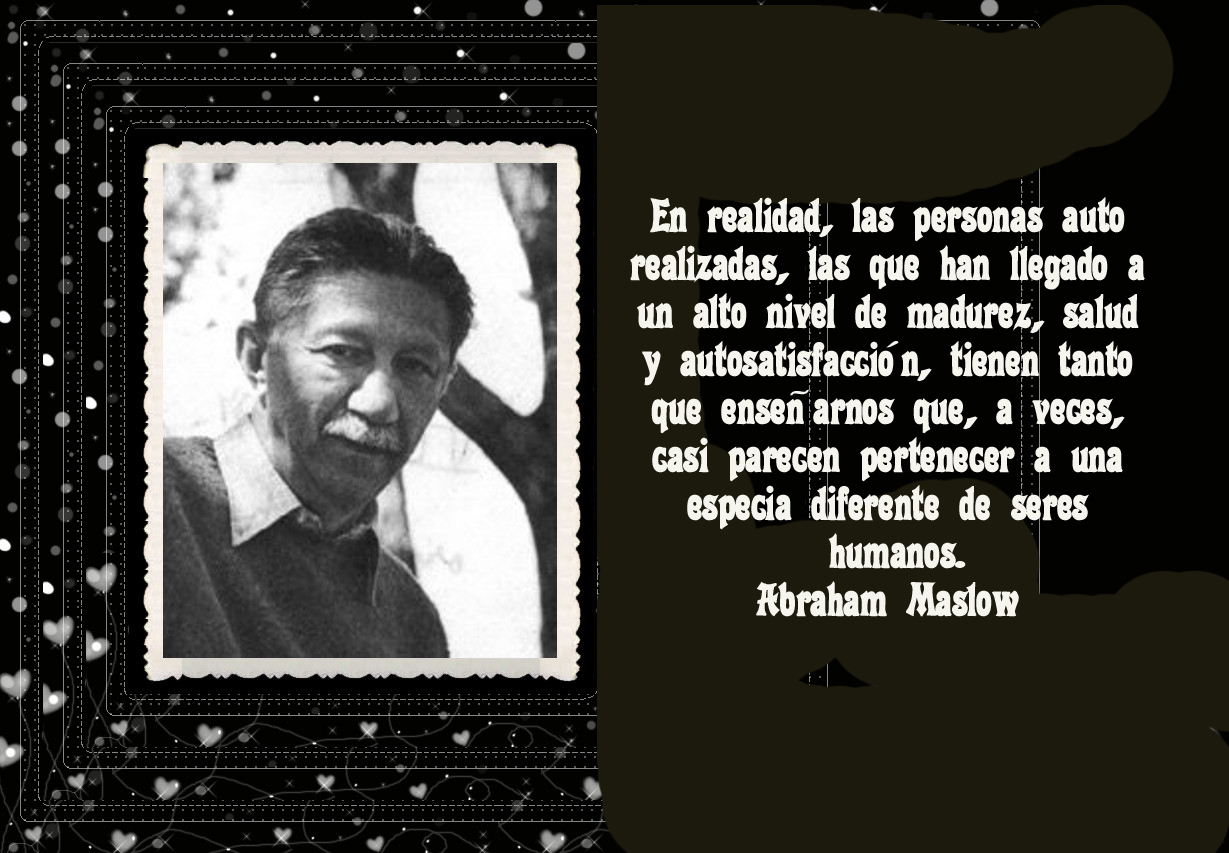
Maslow (1908- 1970)

Abraham Maslow: Teorías de la motivación 

Resultado de imagen para abraham maslowResultado de imagen para abraham maslow


Teoría de Jerarquía de Necesidades de Maslow

Teoría de la jerarquía de necesidades


Probablemente estemos en lo cierto al decir que la teoría más conocida de la motiva­ción es la jerarquía de necesidades de Abraham Maslow. Él presenta la hipótesis de que dentro de todo ser humano existe una jerarquía de las siguientes cinco nece­sidades.
  • Fisiológicas: incluye el hambre, la sed, el abrigo, el sexo y otras necesidades corporales
  • De seguridad: incluye la seguridad y protección de daños físicos y emocio­nales.
  • Sociales: incluye afectos, la sensación de pertenencia, aceptación y amistad.
  • De Ego: incluye factores internos de estima, como el respeto a uno mis­mo, la autonomía y los logros; y factores externos como el status, el recono­cimiento y la atención.
  • De autorrealización: el impulso de ser lo que se es capaz de ser; incluye el crecimiento, alcanzar el potencial de uno y la autosatisfacción.

Esquema de las Necesidades
A medida que se satisface cada una de estas necesidades en lo sustancial, el siguiente nivel de necesidades se vuelve do­minante. En términos de la figura, el individuo sube por los escalones de la jerarquía. Desde el punto de vista de la motiva­ción, la teoría indica que, aunque ninguna necesidad se satisface siempre, una necesidad que ha quedado en gran parte satisfecha ya no motiva. De manera que si uno desea motivar a alguien, de acuerdo con Maslow, necesita comprender en qué nivel de la je­rarquía está en la actualidad, y enfocarse a la satisfacción de las necesidades en ese nivel o el siguiente superior.

Maslow separa las cinco necesidades en órdenes superior e inferior. Describió las necesidades fisiológicas y de seguridad como de orden inferior, y las sociales, de estima y de autorrealización como necesi­dades de orden superior. Esta diferenciación entre los dos órdenes se hizo a partir del criterio de que las necesidades de orden superior quedan satisfechas en lo inter­no (dentro de la persona), mientras que las necesidades de orden inferior quedan satisfechas predominantemente en lo externo (por el pago, los contratos sindicales y el ejercicio de un puesto, por ejemplo). De hecho, la conclusión natural a la que se debe llegar partiendo de la clasificación de Maslow es que, en tiempos de abundan­cia económica, casi todos los trabajadores con empleos permanentes han satisfecho de manera considerable sus necesidades de orden inferior.
La teoría de las necesidades de Maslow ha recibido un amplio reconocimiento, en particular entre los administradores profesionales. Se puede atribuir esto a la ló­gica intuitiva y a la facilidad de su comprensión. Sin embargo, por desgracia, la investigación no respalda en general dicha teoría. Maslow no proporcionó una veri­ficación empírica, y varios estudios que intentaron respaldar su teoría encontraron que no había apoyo para la misma.

Las viejas teorías, en especial aquellas que son intuitivamente lógicas, parecen difíciles de abatir. Un investigador revisó la evidencia y llegó a la conclusión de que aunque tiene una gran popularidad en la sociedad, la jerarquía de necesidades, como teoría, continúa recibiendo poco apoyo empírico”. Además, el investigador concluyó que “la investigación disponible ciertamente debe hacer que estemos re­nuentes a aceptar sin reservas las implicaciones de la jerarquía de Maslow” ·  Otra revisión llegó a la misma conclusión. Se ha encontrado poco respaldo para la pre­dicción de que las estructuras de las necesidades estén organizadas de acuerdo con las dimensiones propuestas por Maslow, de que las necesidades insatisfechas moti­ven, o que una necesidad satisfecha active el traslado a un nuevo nivel de necesidades.

Erik Erikson (1902- 1994)

 Resultado de imagen para ERIK eriksonResultado de imagen para ERIK erikson


ETAPAS DEL DESARROLLO

Erikson afirma que los seres humanos con un desarrollo sano deben pasar a través de ocho etapas entre la infancia y la edad adulta tardía. En cada etapa, la persona se enfrenta, y es de esperar que domine, nuevos retos. Cada etapa se basa en la culminación con éxito de las etapas anteriores. Si los retos no se completan con éxito en una fase, es de esperar que reaparezcan como problemas en el futuro.
Principales elementos de la teoría de Erikson:
  • Identidad del yo: El yo hace referencia al sentido consciente de uno mismo que desarrollamos a través de la interacción social. Según Erikson, nuestra identidad del yo está en constante cambio debido a las nuevas experiencias e información que adquirimos a través de nuestra interacción diaria con los demás.
  • Competencia: Además de la identidad del yo, Erikson cree que un sentido de competencia motiva conductas y acciones. Cada etapa de la teoría de Erikson pone interés en cómo adquirir competencias en un área de la vida. Si la etapa se maneja bien, la persona se sentirá satisfecha y segura. Si la etapa se gestiona mal, en la persona va a surgir un sentimiento de inadecuación.
  • Conflictos: Erikson cree que la gente experimenta en cada etapa un conflicto que sirve como punto de inflexión en su desarrollo. En opinión de Erikson, esos conflictos se centran bien en el desarrollo de una cualidad psicológica o en no lograr desarrollar esa cualidad. Durante esos momentos, el potencial para el crecimiento personal es alto, pero también lo es el potencial para el fracaso.
Etapa Conflicto básico Eventos importantes Resultado
Infancia postnatal (nacimiento a 18 meses) Confianza frente a desconfianza Alimentación Los niños desarrollan un sentido de confianza cuando los cuidadores proporcionan fiabilidad, atención y afecto. Su ausencia dará lugar a la desconfianza.
Primera infancia (2 a 3 años) Autonomía frente a vergüenza y duda Control del esfínter Los niños desarrollan un sentido de control personal sobre las habilidades físicas y un sentido de independencia. El éxito conduce a sentimientos de autonomía.   La falta de resultados produce sentimientos de vergüenza y duda.
Preescolar (3 a 5 años) Iniciativa frente a culpa Exploración Los niños comienzan a imponer su el control y poder sobre el entorno. El éxito en esta etapa conduce a un sentido de propósito. Los niños que intentan ejercer demasiado poder experimentan desaprobación, lo que produce un sentimiento de culpa.
Edad escolar (6 a 11 años) Laboriosidad frente a inferioridad La escuela Los niños necesitan enfrentarse a las nuevas demandas sociales y académicas. El éxito conduce a un sentido de competencia, mientras que los resultados de fracaso producen sentimientos de inferioridad.
Adolescencia (12 a 18 años) Identidad frente a confusión de roles Relaciones sociales Durante la adolescencia, los niños exploran su independencia y el desarrollo de un sentido de sí mismos.   Los que reciben el estímulo y refuerzo adecuados a través de la exploración personal saldrán de esta etapa con un fuerte sentido de sí mismos y una sensación de independencia y control. Los que continúan inseguros con sus creencias y deseos tienden a experimentar inseguridad y confusión acerca de su identidad y futuro.
Primera edad adulta (19 a 40 años) Intimidad frente a aislamiento Relaciones Los adultos jóvenes forman relaciones amorosas íntimas con otras personas. Tener un fuerte sentido de identidad es clave para ello. El éxito lleva a relaciones seguras y comprometidas, mientras que la falta de éxito puede provocar sentimientos de soledad y aislamiento emocional.
Edad adulta media (40 a 65 años) Generatividad frente a estancamiento Trabajo y paternidad Los adultos necesitan crear o consolidar cosas que sobrevivirán a ellos, a menudo teniendo niños o creando un cambio positivo que beneficie a otras personas. El éxito conduce a sentimientos de utilidad y logro, mientras que los resultados de fracaso producen una débil participación en el mundo.
Madurez (65 hasta muerte) Integridad del yo frente a desesperación Reflexión sobre la vida Los adultos mayores necesitan contemplar su vida anterior y sentir una sensación de plenitud. El éxito en esta etapa conduce a sentimientos de sabiduría, mientras que los resultados de fracaso producen pesar, amargura y desesperación.

jueves, 29 de septiembre de 2016

Sobre la evolución del lenguaje

Noam Chomsky on the Evolution of Language: A Biolinguistic Perspective

Saturday, 24 September 2016 00:00By C.J. Polychroniou, Truthout | Interview
Human language is crucial to the scientific quest to understand what kind of creatures we are and, thus crucial to unlocking the mysteries of human nature.
In the interview that follows, Noam Chomsky, the scholar who single-handedly revolutionized the modern field of linguistics, discusses the evolution of language and lays out the biolinguist perspective -- the idea that a human being's language represents a state of some component of the mind. This is an idea that continues to baffle many non-experts, many of whom have sought to challenge Chomsky's theory of language without really understanding it.
Journalist and ''radical chic" reactionary writer Tom Wolfe was the latest to do so in his laughable new book, The Kingdom of Speech, which seeks to take down Charles Darwin and Noam Chomsky through sarcastic and ignorant remarks, making vitriolic attacks on their personalities and expressing a deep hatred for the Left. Indeed, this much-publicized book not only displays amazing ignorance about evolution in general and the field of linguistics in particular, but also aims to portray Noam Chomsky as evil -- due to his constant and relentless exposure of the crimes of US foreign policy and other challenges to the status quo.
C. J. Polychroniou: Noam, in your recently published book with Robert C. Berwick (Why Only Us: Language and Evolution, MIT Press 2016), you address the question of the evolution of language from the perspective of language as part of the biological world. This was also the theme of your talk at an international physics conference held this month in Italy, as it seems that the scientific community appears to have a deeper appreciation and a more subtle understanding of your theory of language acquisition than most social scientists, who seem to maintain grave reservations about biology and the idea of human nature in general. Indeed, isn't it the case that the specific ability of our species to acquire any language was a major theme of interest to the modern scientific community from the time of Galileo?
Noam Chomsky: This is quite true. At the outset of the modern scientific revolution, Galileo and the scientist-philosophers of the monastery of Port Royal issued a crucial challenge to those concerned with the nature of human language, a challenge that had only occasionally been recognized until it was taken up in the mid-20th century and became the primary concern of much of the study of language. For short, I'll refer to it as the Galilean challenge. These great founders of modern science were awed by the fact that language permits us (in their words) to construct "from 25 or 30 sounds an infinite variety of expressions, which although not having any resemblance in themselves to that which passes through our minds, nevertheless do not fail to reveal all of the secrets of the mind, and to make intelligible to others who cannot penetrate into the mind all that we conceive and all of the diverse movements of our souls."
We can now see that the Galilean challenge requires some qualifications, but it is very real and should, I think, be recognized as one of the deepest insights in the rich history of inquiry into language and mind in the past 2500 years.
The challenge had not been entirely ignored. For Descartes, at about the same time, the human capacity for unbounded and appropriate use of language was a primary basis for his postulation of mind as a new creative principle. In later years, there is occasional recognition that language is a creative activity that involves "infinite use of finite means," in Wilhelm von Humboldt's formulation and that it provides "audible signs for thought," in the words of linguist William Dwight Whitney a century ago. There has also been awareness that these capacities are a species-property, shared by humans and unique to them -- the most striking feature of this curious organism and a foundation for its remarkable achievements. But there was never much to say beyond a few phrases.
But why is it that the view of language as a species-specific capacity is not taken up until well into the 20th century?
There is a good reason why the insights languished until mid-20th century: intellectual tools were not available for even formulating the problem in a clear enough way to address it seriously. That changed thanks to the work of Alan Turing and other great mathematicians who established the general theory of computability on a firm basis, showing in particular how a finite object like the brain can generate an infinite variety of expressions. It then became possible, for the first time, to address at least part of the Galilean challenge directly -- although, regrettably, the earlier history [for example, the history of Galileo's and Descartes' inquiries into the philosophy of language, as well as the Port-Royal Grammar by Antoine Arnauld and Claude Lancelot] was entirely unknown at the time.
With these intellectual tools available, it becomes possible to formulate what we may call the Basic Property of human language: The language faculty provides the means to construct a digitally infinite array of structured expressions, each of which has a semantic interpretation expressing a thought, and each of which can be externalized by means of some sensory modality. The infinite set of semantically interpreted objects constitutes what has sometimes been called a "language of thought": the system of thoughts that receive linguistic expression and that enter into reflection, inference, planning and other mental processes, and when externalized, can be used for communication and other social interactions. By far, the major use of language is internal -- thinking in language.
Can you please expand on the notion of the internal language?
We now know that although speech is the usual form of sensory motor externalization, it can just as well be sign or even touch, discoveries that require a slight reformulation of the Galilean challenge. A more fundamental qualification has to do with the way the challenge is formulated: in terms of production of expressions. So formulated, the challenge overlooks some basic issues. Production, like perception, accesses the internal language but cannot be identified with it. We must distinguish the internalized system of knowledge from the actions that access it. The theory of computability enables us to establish the distinction, which is an important one, familiar in other domains.
Consider, for example, human arithmetical competence. In studying it, we routinely distinguish the internal system of knowledge from the actions that access it, like multiplying numbers in our head, an action that involves many factors beyond intrinsic knowledge; memory constraints, for example. The same is true of language. Production and perception access the internal language but involve other factors as well, including again short-term memory, matters that began to be studied with some care in the early days of concern with the Galilean challenge, now reformulated to focus on the internal language, the system of knowledge that is accessed by actual production and by perception.
Does this mean that we have solved the mystery of the internal language? For example, the whole idea continues to be questioned in some quarters, although it is widely accepted, apparently, by most scientists.
There has been considerable progress in understanding the nature of the internal language, but its free creative use remains a mystery. That comes as no surprise. In a recent review of the state of the art concerning far simpler cases of voluntary action, two leading researchers, neuroscientists Emilio Bizzi and Robert Ajemian, write that we are beginning to learn something about the puppet and the strings, but the puppeteer remains shrouded in mystery. That is even more dramatically true for such creative acts as the normal [everyday] use of language, the unique human capacity that so impressed the founders of modern science.
In formulating the Basic Property, we are assuming that the faculty of language is shared among humans. That seems solidly established. There are no known group differences in language capacity, and individual variation is found only at the margins. More generally, genetic variation among humans is quite slight, not too surprisingly, given the recency of common origins.
The fundamental task of inquiry into language is to determine the nature of the Basic Property -- the genetic endowment that underlies the faculty of language. To the extent that its properties are understood, we can seek to investigate particular internal languages, each an instantiation of the Basic Property, much as each individual visual system is an instantiation of the human faculty of vision. We can investigate how the internal languages are acquired and used, how the language faculty itself evolved, its basis in human genetics and the ways it functions in the human brain. This general program of research has been called the Biolinguistic Program. The theory of the genetically-based language faculty is called Universal Grammar; the theory of each individual language is called its Generative Grammar.
But languages vary greatly from one another, so what's the link between Generative Grammar and Universal Grammar?
Languages appear to be extremely complex, varying radically from one another. And indeed, a standard belief among professional linguists 60 years ago was that languages can vary in arbitrary ways and each must be studied without preconceptions. Similar views were held at the time about organisms generally. Many biologists would have agreed with molecular biologist Gunther Stent's conclusion that the variability of organisms is so free as to constitute "a near infinitude of particulars which have to be sorted out case by case." When understanding is thin, we expect to see extreme variety and complexity.
However, a great deal has been learned since then. Within biology, it is now recognized that the variety of life forms is very limited, so much so that the hypothesis of a "universal genome" has been seriously advanced. My own feeling is that linguistics has undergone a similar development, and I will keep here to that strand in contemporary study of language.
The Basic Property takes language to be a computational system, which we therefore expect to observe general conditions on computational efficiency. A computational system consists of a set of atomic elements and rules to construct more complex ones. For generation of the language of thought, the atomic elements are word-like, though not words; for each language, the set of these elements is its lexicon. The lexical items are commonly regarded as cultural products, varying widely with experience and linked to extra-mental entities [objects entirely outside of our minds, such as the tree outside the window] -- an assumption expressed in the titles of standard works, such as W.V. Quine's influential study Word and Object. Closer examination reveals a very different picture, one that poses many mysteries. Let's put that aside for now, turning to the computational procedure.
Clearly, we will seek the simplest computational procedure consistent with the data of language, for reasons that are implicit in the basic goals of scientific inquiry. It has long been recognized that simplicity of theory translates directly to explanatory depth. A more specific version of this quest for understanding was provided by a famous dictum of Galileo's, which has guided the sciences since their modern origins: nature is simple, and it is the task of the scientist to demonstrate this, from the motion of the planets, to an eagle's flight, to the inner workings of a cell, to the growth of language in the mind of a child. Linguistics has an additional motive of its own for seeking the simplest theory: it must face the problem of evolvability. Not a great deal is known about evolution of modern humans, but the few facts that are well established, and others that have recently been coming to light, are rather suggestive and conform well to the conclusion that the language faculty is near optimal for a computational system, the goal we should seek on purely methodological grounds.
Did language exist before the emergence of Homo Sapiens?
One fact that does appear to be well established is, as I have already mentioned, that the faculty of language is a true species property, invariant among human groups -- and furthermore, unique to humans in its essential properties. It follows that there has been little or no evolution of the faculty since human groups separated from one another. Recent genomic studies place this date not very long after the appearance of anatomically modern humans about 200,000 years ago, perhaps some 50,000 years later, when the San group in Africa separated from other humans. There is some evidence that it might have been even earlier. There is no evidence of anything like human language, or symbolic activities altogether, before the emergence of modern humans, Homo Sapiens Sapiens. That leads us to expect that the faculty of language emerged along with modern humans or not long after -- a very brief moment in evolutionary time. It follows, then, that the Basic Property should indeed be very simple. The conclusion conforms to what has been discovered in recent years about the nature of language -- a welcome convergence.
The discoveries about early separation of the San people are highly suggestive ... [they] have significantly different externalized languages. With irrelevant exceptions, their languages are all and only the languages with phonetic clicks, with corresponding adaptations in the vocal tract. The most likely explanation for these facts, developed in detail in current work by Dutch linguist Riny Huijbregts, is that possession of internal language preceded separation, which in turn preceded externalization, the latter in somewhat different ways in separated groups. Externalization seems to be associated with the first signs of symbolic behavior in the archaeological record, after the separation. Putting these observations together, it seems that we are reaching a stage in understanding where the account of evolution of language can perhaps be fleshed out in ways that were unimaginable until quite recently.
When do universal properties of language come to light?
Universal properties of the language faculty began to come to light as soon as serious efforts were undertaken to construct generative grammars, including quite simple ones that had never been noticed, and that are quite puzzling -- a phenomenon familiar in the history of the natural sciences. One such property is structure-dependence: the rules that yield the language of thought attend solely to structural properties, ignoring properties of the externalized signal, even such simple properties as linear order.
To illustrate, consider the sentence birds that fly instinctively swim. It is ambiguous: the adverb "instinctively" can be associated with the preceding verb (fly instinctively) or the following one (instinctively swim). Suppose now that we extract the adverb from the sentence, forming instinctively, birds that fly swim. Now the ambiguity is resolved: The adverb is construed only with the linearly more remote but structurally closer verb swim, not the linearly closer but structurally more remote verb fly. The only possible interpretation -- birds swim -- is the unnatural one, but that doesn't matter: the rules apply rigidly, independent of meaning and fact. What is puzzling is that the rules ignore the simple computation of linear distance and keep to the far more complex computation of structural distance.
The property of structure dependence holds for all constructions in all languages, and it is indeed puzzling. Furthermore, it is known without relevant evidence, as is evident in cases like the one I just gave and innumerable others. Experiment shows that children understand that rules are structure-dependent as early as they can be tested, by about age 3, and do not make errors -- and are, of course, not instructed. We can be quite confident, then, that structure-dependence follows from principles of universal grammar that are deeply rooted in the human language faculty. There is evidence from other sources that supports the conclusion that structure-dependence is a true linguistic universal, deeply rooted in language design. Research conducted in Milan a decade ago, initiated by Andrea Moro, showed that invented languages keeping to the principle of structure-dependence elicit normal activation in the language areas of the brain, but much simpler systems using linear order in violation of these principles yield diffuse activation, implying that experimental subjects are treating them as a puzzle, not a language. Similar results were found in work by Neil Smith and Ianthi Tsimpli in their investigation of a cognitively deficient but linguistically gifted subject. They also made the interesting observation that [people with average cognitive abilities] can solve the problem if it is presented to them as a puzzle, but not if it is presented as a language, presumably activating the language faculty.
The only plausible conclusion, then, is that structure-dependence is an innate property of the language faculty, an element of the Basic Property. Why should this be so? There is only one known answer, and fortunately, it is the answer we seek for general reasons: The computational operations of language are the simplest possible ones. Again, that is the outcome that we hope to reach on methodological grounds, and that is to be expected in the light of the evidence about evolution of language already mentioned.
What about the so-called representational doctrine about language? What makes it a false idea for human language?
As I mentioned, the conventional view is that atomic elements of language are cultural products, and that the basic ones -- those used for referring to the world -- are associated with extra-mental entities. This representationalist doctrine has been almost universally adopted in the modern period. The doctrine appears to hold for animal communication: a monkey's calls, for example, are associated with specific physical events. But the doctrine is radically false for human language, as was recognized as far back as classical Greece.
To illustrate, let's take the first case that was discussed in pre-Socratic philosophy, the problem posed by Heraclitus: how can we cross the same river twice? To put it differently, why are two appearances understood to be two stages of the same river? Contemporary philosophers have suggested that the problem is solved by taking a river to be a four-dimensional object, but that simply restates the problem: why this object and not some different one, or none at all?
When we look into the question, puzzles abound. Suppose that the flow of the river has been reversed. It is still the same river. Suppose that what is flowing becomes 95 percent arsenic because of discharges from an upstream plant. It is still the same river. The same is true of other quite radical changes in the physical object. On the other hand, with very slight changes it will no longer be a river at all. If its sides are lined with fixed barriers and it is used for oil tankers, it is a canal, not a river. If its surface undergoes a slight phase change and is hardened, a line is painted down the middle, and it is used to commute to town, then it is a highway, no longer a river. Exploring the matter further, we discover that what counts as a river depends on mental acts and constructions. The same is true, quite generally, of even the most elementary concepts: tree, water, house, person, London, or in fact, any of the basic words of human language.  Radically, unlike animals, the items of human language and thought uniformly violate the representationalist doctrine.
Furthermore, the intricate knowledge of the means of even the simplest words, let alone others, is acquired virtually without experience. At peak periods of language acquisition, children are acquiring about a word an hour, that is, often on one presentation. It must be, then, that the rich meaning of even the most elementary words is substantially innate. The evolutionary origin of such concepts is a complete mystery, one that may not be resolvable by means available to us.
So we definitely need to distinguish speech from language, right?
Returning to the Galilean challenge, it has to be reformulated to distinguish language from speech, and to distinguish production from internal knowledge -- the latter an internal computational system that yields a language of thought, a system that might be remarkably simple, conforming to what the evolutionary record suggests. Secondary processes map the structures of language to one or another sensory-motor system for externalization. These processes appear to be the locus of the complexity and variety of linguistic behavior, and its mutability over time.
There are suggestive recent ideas about the neural basis for the operations of the computational system, and about its possible evolutionary origins. The origin of the atoms of computation, however, remains a complete mystery, as does a major question that concerned those who formulated the Galilean challenge: the Cartesian question of how language can be used in the normal creative way, in a manner appropriate to situations but not caused by them, in ways that are incited and inclinedbut not compelled,in Cartesian terms. The mystery holds for even the simplest forms of voluntary motion, as discussed earlier.
A great deal has been learned about language since the Biolinguistic Program was initiated. It is fair to say, I think, that more has been learned about the nature of language, and about a very wide variety of typologically different language, than in the entire 2,500 year history of inquiry into language. But as is familiar in the sciences, the more we learn, the more we discover what we do not know. And the more puzzling it seems.
Copyright, Truthout. May not be reprinted without permission.

C.J. POLYCHRONIOU

C.J. Polychroniou is a political economist/political scientist who has taught and worked in universities and research centers in Europe and the United States. His main research interests are in European economic integration, globalization, the political economy of the United States and the deconstruction of neoliberalism's politico-economic project. He is a regular contributor to Truthout as well as a member of Truthout's Public Intellectual Project. He has published several books and his articles have appeared in a variety of journals, magazines, newspapers and popular news websites. Many of his publications have been translated into several foreign languages, including Croatian, French, Greek, Italian, Portuguese, Spanish and Turkish.

RELATED STORIES

Language Is A Virus
By Tom Tomorrow, This Modern World | Political Image
Chomsky: It Is All Working Quite Well for the Rich, Powerful
By CJ Polychroniou and Anastasia Giamali, Truthout | Interview
Chomsky Turns 86: Happy Birthday, Noam
By Dan Falcone, Truthout | Interview

lunes, 1 de agosto de 2016

Cerebro 2

¿Es tu cerebro masculino o femenino?


Compartir
Hombre y mujer con aparatos en la cabeza cómicoImage copyrightGETTY IMAGES
Image caption¿Se podrá ver la diferencia en nuestro cerebro?

Hay quienes te dirían que los hombres son de Marte y las mujeres son de Venus.

De acuerdo con la mitología popular, las niñas son agraciadas con la inteligencia emocional y los niños tienen facilidad para la lógica y la mecánica.
Aunque los comportamientos típicos femeninos y masculinos efectivamente se reproducen en nuestra vida cotidiana, numerosos estudios han demostradoningún género tiene una mejor aptitud para una u otra tarea cognitiva.
Entonces, ¿será que las diferencias entre hombres y mujeres nacen con nosotros, derivadas de la cognición de nuestro cerebro, o son comportamientos aprendidos?

¿Qué hay en un cerebro?

señales de Marte y VenusImage copyrightTHINKSTOCK
Image captionHay quienes dicen que pertenecemos a mundos diferentes.
Si bien es cierto que las diferencias cognitivas entre hombres y mujeres son mínimas, hay diferencias en la forma en que responden a la enfermedad y el tratamiento.
  • Derrames
Los hombres son menos propensos a tener derrames fatales.
Los derrames afectan a las mujeres con más severidad que a los hombres, particularmente después de la menopausia.
Las células cerebrales de las mujeres mueren más rápido tras un derrame debido a los cambios hormonales.
  • La enfermedad de Alzheimer
Las mujeres de 60 años y más tienen el doble de probabilidades de desarrollar la enfermedad de Alzheimer que los hombres.
La investigación sobre las diferencias en el cerebro entre los géneros podría cambiar la forma en que tratamos las enfermedades de Huntington, de Alzheimer y trastornos psiquiátricos como el bipolar.
Escena en una exposición de arte frente a la imagen de un cerebro.Image copyrightAP
Image captionLas mujeres sufren más.
  • El dolor
Los hombres y las mujeres experimentan dolor de manera diferente.
Las mujeres experimentan más dolor durante sus vidas, al sufrir por ejemplo 40% más dolor por osteoporosis que los hombres.
Eso puede alterar la manera en la que tratamos el dolor.
  • Heridas en la cabeza
Las mujeres se recuperan de lesiones en la cabeza más rápido debido a los altos niveles de progesterona.
Un estudio con ratas de 2010 mostró que la hormona menstrual progesterona mejoraba las posibilidades de supervivencia.

¿El tamaño importa?

Un estudio de 2014 de la Universidad de Cambridge, en Inglaterra, confirmó que el cerebro promedio de los hombres es 10% más grande que el de las mujeres.
Pero más grande no significa necesariamente mejor.
Cerebro de hombre (der.) y de mujer (izq.)
Image captionA la izquierda, el del hombre; a la derecha, el de la mujer: la diferencia de tamaño existe pero ¿y qué?
"Es sorpresivamente difícil vincular las diferencias en el comportamiento con la anatomía", le dice a la BBC la anatomista Alice Roberts, mientras observa una bandeja con cerebros humanos.
"Hay mucho debate sobre los cerebros de ambos géneros pero hay una cosa en la que todo el mundo está de acuerdo: los cerebros de los hombres tienden a ser más grandes que los de las mujeres".
No obstante, señala, no podemos olvidar que hay una enorme variedad entre los cerebros de ambos géneros, de manera que no es raro encontrar femeninos grandes y masculinos pequeños.
Y, a pesar de esa diferencia de 10% en promedio, los científicos no han encontrado ninguna diferencia en los niveles de inteligencia.
En pruebas de coeficiente intelectual, los hombres y las mujeres obtienen más o menos las mismas calificaciones.
TestImage copyrightTHINKSTOCK
Image captionLas pruebas muestran que el tamaño no importa.
"Además de las diferencias de tamaño, se ha dicho que hay diferencias en las estructuras en el interior del cerebro", explica Roberts.
"Una de ellas es la conexión entre el sistema y las hormonas, la parte del cerebro que se comunica con los testículos y los ovarios. Pero eso no se ha podido demostrar".
"Otra área que algunos sospechan puede ser distinta es el hipocampo, que está vinculado a la memoria. Tiende a ser más grande en los cerebros de las mujeres. Pero en las pruebas de memoria, tampoco se ha encontrado ningún vínculo... ninguna diferencia".
"Así que aunque podemos ver algunas diferencias en la estructura, eso no se traduce necesariamente en diferencias obvias en el comportamiento", concluye la anatomista.

Por vías diferentes

Entonces, ¿cuál es la causa de las diferencias entre el cerebro promedio de los hombres y mujeres?
Gráfico de cerebro de hombre y mujer
Image caption¿Estaremos conectados de distintas formas?
Un equipo de científicos en Filadelfia (EE.UU.), dirigidos por el Dr. Verma Ragini, mapeó las conexiones neurológicas en el cerebro de los hombres y las mujeres.
Encontraron diferencias de género en los patrones de conexión o "vías" entre los dos hemisferios del cerebro.
Las mujeres muestran vías más fuertes entre los hemisferios derecho e izquierdo de sus cerebros.
Las vías en los hombres conectan el frente y la parte posterior del cerebro.
El equipo observó que esta divergencia no existe en los niños, sólo se desarrolla en la adolescencia.

¿Naturaleza o crianza?

Puede ser tentador pensar que los cerebros de los dos sexos están "integrados" de diferentes maneras.
Pero el cerebro es muy plástico, y se desarrolla en respuesta a cómo se usa.
Es por ello que cualquier diferencia en las conexiones podría surgir debido a factores sociales y culturales, incluidos los estereotipos de género.
CerebroImage copyrightSCIENCE PHOTO LIBRARY
Image captionPor más que lo examinan, aún no encuentran lugares que nos hagan distintos.
Es probable que los niños y los hombres puedan desarrollar mejores habilidades espaciales, ya que siempre se les ha animado a hacer deporte.
Las mujeres pueden ser mejores para ponerse en el lugar de otros y ayudar, porque eso es lo que la sociedad espera de ellas.
A pesar de que es fascinante poder trazar la arquitectura del cerebro vivo, la verdad es que las diferencias entre los cerebros masculinos y femeninos son muy pocas y pequeñas.